
A committee established to forecast the required number of physicians in the coming years, known as the "Medical Workforce Supply and Demand Estimation Committee," has determined that the highest projected shortage of doctors by 2040 could reach 11,136. Although the government intends to determine the medical school enrollment limit for the 2027 session according to these findings, considerable challenges are anticipated before the cap is decided because of intense resistance from the healthcare sector.
A meeting was conducted by the committee on the 30th, during which they discussed and released the 'Estimates of Medical Workforce Supply and Demand.' Under the Yoon Suk-yeol administration, the number of available spots at medical schools was raised by 1,509 for the 2025 academic term; however, due to significant resistance from healthcare professionals, this decision was reversed, resulting in no expansion for 2026. The plan was previously set to establish the enrollment numbers for 2027 and subsequent years via conversations within the committee.
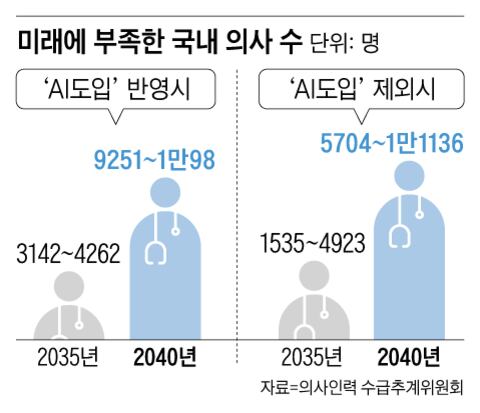
On that particular day, the committee determined the anticipated shortfall of physicians by utilizing information regarding healthcare facilities, expected population growth, and current physician availability. The outcome indicated that by 2035, the deficit could vary between 1,535 and 4,923, and by 2040, between 5,704 and 11,136. Moreover, the committee examined different situations accounting for shifts in doctors' efficiency and workdays caused by the integration of artificial intelligence. Therefore, the predicted shortage was estimated at 3,142 to 4,262 by 2035, and 9,251 to 10,098 by 2040.
The administration under Yoon Suk-yeol referred to a report predicting a deficit of 15,000 physicians by 2035 when advocating an expansion of medical school enrollment caps by 2,000. Although the committee’s findings show a smaller number, they still confirm the expectation of a doctor shortage. The panel includes 15 individuals, eight of whom were proposed by medical organizations such as the National Council of Medical Schools, the Korean Medical Association (KMA), and the Korean Intern Resident Association (KIRA). Chairperson Kim Tae-hyun stated during a media conference, "I think having most members selected from recommendations within the medical field will help ensure wider recognition of these outcomes."
The Department of Health and Welfare intends to convene the Health and Medical Policy Review Committee (Bojungsim) in January to determine the number of medical students admitted for 2027 and subsequent years following the committee's deliberations. Bojungsim will evaluate whether to acknowledge the projected physician shortfall and, if approved, establish how many additional physicians should be added within specific timeframes. With the committee having previously identified a potential future shortage of doctors, it is anticipated that the government may raise the enrollment limit at medical schools. Following its initial gathering, Bojungsim mentioned that it aims to set the quota in order to ensure an adequate supply of critical and local healthcare professionals.
According to the Implementation Regulations of the Higher Education Act, the number of spots available in medical schools is determined by the Minister of Education after consulting with the Minister of Health and Welfare. The overall limit is established by the Ministry of Health and Welfare, which then assigns the quotas to each university. After the total quota for 2027 has been finalized, the Ministry of Education will collect requests from institutions seeking an increase and decide how many students each university can admit via the 'Medical School Student Quota Allocation Committee.' Every institution needs to provide an updated enrollment plan to the Korean Council for University Education by April 30 of the following year based on their assigned quota. Given this procedure, the overall cap should be confirmed by Bojungsim by the end of January next year at the earliest.
The medical profession is firmly against this decision. A representative from the Korean Medical Association mentioned, "The committee approached the issue in an outdated manner, largely ignoring crucial factors related to the future healthcare landscape such as artificial intelligence integration, advances in medical technologies, and shifts in efficiency." They added, "Quickly reaching an unrefined verdict repeats past errors similar to the '2,000-increase incident.'" KIRA also released a statement showing disappointment with the committee's rushed determination, noting, "Calculations using inadequate information are akin to blunders made by earlier administrations, and we expect sound decisions from Bojungsim." Considering that KMA Chairman Kim Taek-woo had previously warned, "If satisfactory outcomes aren’t achieved, we'll employ every possible measure, even going on strike," worries grow that the fragile resolution of tensions between the medical field and authorities could reignite.
☞Committee for Assessing Medical Staff Supply and Demand
An autonomous organization formed pursuant to the Basic Health and Medical Services Act aims to carry out medium-to-long-range projections regarding the availability and needs of healthcare professionals. Its membership includes 15 individuals: 8 nominated by medical organizations (such as physician associations), 4 from patient advocacy and community groups, and 3 selected from academic bodies and research institutes. The government will determine the number of available spots at medical schools starting from 2027 onwards through meetings held by the Health and Medical Policy Advisory Committee, taking into account the findings provided by this group.
Posting Komentar